
Skip to content
  • EN
    • FR
    • ES
Documentation request
  • Actualité
  • 09/03/2026

“Digital Trends 2026: What Impact and Opportunities for Training?”

Article “Digital Trends 2026: What Impact and Opportunities for Training?”

https://www.blogdumoderateur.com/tendances-digital-guide-2026/?utm_source=blogdumoderateur&utm_medium=email&utm_campaign=newsletter_hebdomadaire&utm_content=media-2

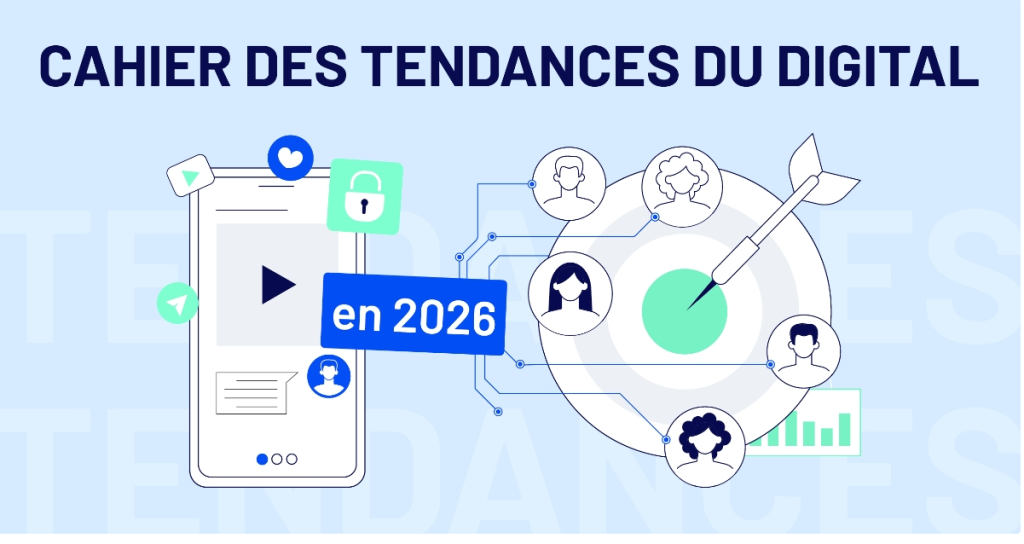
The Digital Trends 2026 guide, produced by BDM in partnership with various experts in the sector, highlights the profound transformations in digital usage. Below is a summary of the key points, followed by an analysis of their potential contributions to the world of training and education.

  1. Summary of the major trends for 2026
    • Dominance of short video (“Snack Content”):
      Short-form content has become the standard. In 2025, nearly 87.5% of internet users watched short videos every week. Brands must now capture attention in less than 3 seconds and deliver a strong message in under 30 seconds.
    • Interactive and immersive videos:
      Video is evolving toward greater interactivity, allowing the viewer to become an active participant (choice of narrative, responses to integrated questionnaires, augmented reality).
    • Generative AI in content creation:
      AI (such as Sora 2 or Veo 3) automates and accelerates video production, with forecasts suggesting that 40% of advertisements will be generated by AI in 2026. The challenge remains maintaining a human touch to preserve authenticity.
    • Growth of voice and conversational search:
      More than 70% of users now prefer voice search. Queries are no longer made through keywords but through full sentences or natural questions.
    • Cybersecurity and data protection:
      With increasingly intrusive data collection and sophisticated AI-driven phishing attacks (deepfakes, realistic voice messages), vigilance and user training are becoming crucial.
    • Evolution of social networks:
      Content saturation is leading to a decline in organic visibility. Success now relies more on quality and community engagement rather than quantity.


  1. Contributions to training, education, and pedagogy

The identified trends offer major opportunities to modernize learning methods:

1- Micro-learning and short-format pedagogy

  • A- Adapting to fragmented attention:
    Inspired by the success of short videos, trainers can design micro-learning modules: knowledge capsules of less than 2 minutes to maximize information retention. Over the years, this retention time has continued to decrease, and the duration of micro-learning follows the same trend. We have moved from 8 minutes to 5 minutes and now to 2 minutes, which increases the number of micro-modules required to create a complete learning pathway.
  • B- Pedagogical sequencing:
    Using fragmented storytelling to maintain long-term engagement by breaking a complex course into several short and impactful sections

2- Active learning through interactivity

  • A- Choose-your-own-adventure scenarios:
    The use of interactive videos allows the creation of simulations where the learner must make narrative choices, promoting an active rather than passive learning approach.
  • B- Integrated assessment:
    Embedding questionnaires directly into the video stream allows immediate validation of acquired knowledge

3- AI and personalization of education

  • A- Adaptation of learning materials:
    Generative AI can make it possible to present the same pedagogical concept in different visual styles or tones to adapt to the specific profile of each student (mass personalization).
  • B-Teacher productivity:
    Accelerating the production of resources (videos, diagrams) frees up time for human support and tutoring.

4- New research interfaces (Voice & AI)

  • A- Answers to natural questions:
    Education must take into account that students search for information in a conversational way. Educational resource databases must therefore be optimized to answer typical questions (“How to solve…”) rather than isolated concepts.

5- Media literacy and cybersecurity education

  • A- Development of critical thinking:
    With the rise of deepfakes and AI-driven phishing, education must include a strong component of digital literacy to help learners detect manipulation and develop critical thinking.
  • B- Protection of privacy:
    Raising students’ awareness about the value of their personal data in the face of massive data collection by applications.

6- Communication and engagement

  • A- Use of SMS/RCS:
    For course reminders, administrative alerts, or learner follow-up, SMS remains an extremely effective channel (98% reading rate) for ensuring the transmission of critical information.

When looking at the latest ISTF studies on Digital Learning trends, many tools are already being used or are currently under development. This abundance of solutions and the regulatory context make adaptation more complex for training organizations and schools… but it also opens incredible opportunities for pedagogy. !https://www.blogdumoderateur.com/tendances-digital-guide-2026/?utm_source=blogdumoderateur&utm_medium=email&utm_campaign=newsletter_hebdomadaire&utm_content=media-2

PrevPrécédent🔬 How flour choice shapes sourdough starter microbes and bread outcomes
  • Documentation

Would you like to find out more?
Request documentation

Access the form
Contact us
Our training courses
  • Manufacturing
  • Sales
  • Management
  • Manufacturing
  • Sales
  • Management
Legal
  • Legal mentions
  • Privacy policy
  • General Condition of Use
  • General Condition of Sales
  • Legal mentions
  • Privacy policy
  • General Condition of Use
  • General Condition of Sales
Social
Facebook
Instagram
Twitter
Linkedin
Youtube
Baguette Academy – Training in Bakery and Pastry Making
© Baguette Academy - 2026
Agence TILD
  • EN
    • FR
    • ES
Documentation request

Qui sommes-nous

  • Le concept
  • Notre équipe
  • Nos formateurs
  • Qualité
  • Nos partenaires

Formations

  • Toutes les formations
  • Éligibles CPF
  • Fabrication
  • Vente
  • Management

Professionnels

  • Toutes les formations professionnelles
  • Artisanat
  • Industriel

Métiers

  • Tous les métiers
  • Artisanat
  • Industriel

Testez votre niveau

FAQ et Lexique

Actualités

Testez nos cours

Contact

Inscription
Documentation
Facebook Instagram Twitter Linkedin Youtube
  • EN
    • FR
    • ES
Documentation request

About us

  • The concept
  • Our team
  • Our instructors
  • Quality
  • Our partners

Courses

  • All the courses
  • Eligible for CPF
  • Manufacturing
  • Sales
  • Management

Professionals

  • All professional training programs
  • Craftmanship
  • Industrial

Professions

  • All professions
  • Craftmanship
  • Industrial

Testez your level

FAQ and Lexicon

News

Test our courses

Contact

Inscription
Documentation
Facebook Instagram Twitter Linkedin Youtube