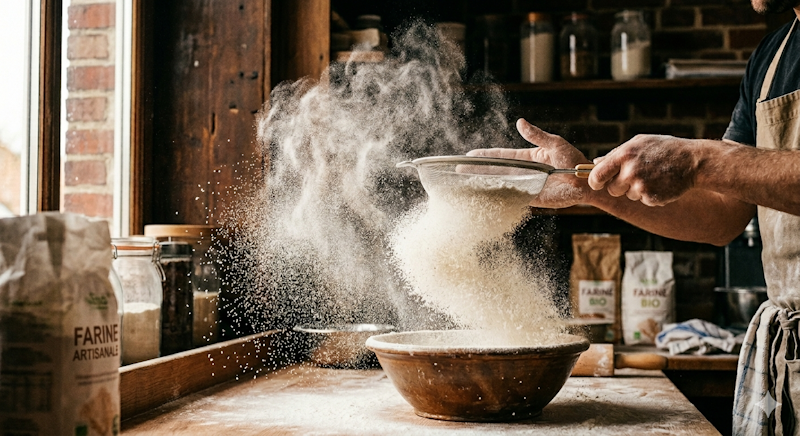
Flour Dust Risk: Background, Measurement and Innovation
The problem of flour dust, a “multi-centenary sea serpent”, remains the leading cause of occupational asthma in Europe, with reporting figures stagnating despite prevention initiatives deemed “fairly episodic”. A European study over the period 2006-2018 confirmed that flour is the major cause of reported occupational asthma, with a third of cases coming from the bakery sector. Similar descriptions of reactions to flour can also be found in cookery and bakery books dating back centuries. Raising awareness in training centers (CFA) remains a delicate matter, as instructors are often uncomfortable talking about the non-neutrality of flour, creating a certain taboo around the subject.
In the face of this inertia, and despite substantial financial investment by the French health insurance scheme (Assurance Maladie) via the Conventions Nationales d’Objectifs (CNO) signed every four years, labor inspectors have initiated a project to reclassify flour as a “hazardous chemical agent”. This measure, seen by some as “provocative”, is intended to stimulate greater awareness and more effective action by the industry. This decision, while shocking the industry, is seen by others as the consequence of a “wait-and-see” attitude and past commitments not followed by sufficient effect.
A comprehensive system is now in place, combining tighter controls and substantial support measures financed to the tune of tens of millions of euros. It is structured around three key areas:
1. Training: Training in the risks associated with flour dust is a prerequisite for access to regional subsidies.
2. Use low-volatility flours: An unprecedented financial aid from the Assurance Maladie covers 70% of the cost of these flours (capped at €1,500) to encourage their trial.
3. Equipment: National subsidies finance 70% of the cost of five types of equipment (mixers, kneaders, dividers, vacuum cleaners, flourers). Regional subsidies are also available.
LEMPA, which has been a reference laboratory for the French health insurance scheme since 2006, plays a central role in equipment homologation and the organization of training courses. All of this funding is guaranteed for the next four years.
Towards New Technical Perspectives: The Pulverulence Index
The introduction of the powder index marks a significant technical advance for the milling industry, opening up a new field of research and innovation. This indicator introduces the notion of “powder morphology”, a science already highly developed in the pharmaceutical and cosmetics sectors, but hitherto little explored for flour. The milling industry is still “far removed” from this expertise, which could be a major source of innovation.
Contrary to popular belief, flour volatility does not depend solely on grain size. Other factors, now better documented, play a crucial role:
– Surface finish of flour particles.
– Particle interactions and electrostatic forces.
– Granule porosity level.
– Harvest effect: significant differences are observed (e.g. 2024 vs. 2025), linked in particular to grain hardness.
– Production parameters: grinding time, grinding type (grinding wheel vs. cylinder) and grinding diagram have a direct impact.
– Varietal effect: a 1 to 3 ratio of volatility was measured between different wheat varieties.
What’s more, the enzymes (alpha-amylase, glucanase) added in the milling process turn out to be much more volatile than the flour itself, with a ratio of up to 1 to 10. Although present in very small proportions, this information is crucial for millers making their own blends and for ingredient manufacturers. The pulverulence index is therefore seen as the starting point for integrating a new technicality and a major innovation lever for flours.
Training and awareness-raising throughout the bakery industry remain the key to reassuring production operators and future bakers. BVP players have the keys in their hands and are already very active in 2026: launch of low-powder traditional flours, major purchases of new equipment by bakers…