Durum wheat: a new frontier for innovation in bakery, Viennese pastry and confectionery (BVP)
While durum wheat (Triticum turgidum durum) immediately conjures up images of al dente pasta, couscous or sunny semolina, it’s now making a very promising name for itself in the world of baking.
While Italy possesses ancestral know-how with its famous Altamura bread (in the Puglia region), France is now seizing on this cereal to make it a real lever for differentiation and food sovereignty.
At a time when BVP artisans and manufacturers are looking for products that are tastier, healthier, “Clean Label” and sustainable, durum wheat is emerging as a solution for the future.
What is its true potential in bread-making? How is it transforming our classic recipes and our approach to Viennese pastries? Analysis of a cereal mutation.
1. Durum wheat vs. soft wheat: two very different technical profiles
Durum wheat is radically different from the common wheat (Triticum aestivum) traditionally used for bakery flour (T65, T55…). Its intrinsic specificities offer new cards to play in the bakery:
– Higher protein content: Durum wheat has a high protein content, ranging from 12 to 15% (compared with 8 to 11% for common wheat). It forms a particularly resistant gluten.
– A signature color: Thanks to the presence of pigments (carotenoids), it has a luminous golden yellow color that instantly gives a warm, appetizing appearance to finished products.
– Unique technological properties: Contrary to popular belief, durum wheat is remarkably extensible. What’s more, its hydration capacity is far superior to that of soft wheat, mechanically increasing dough yield.
2. Food sovereignty and industry commitment: the “100% French” choice
Growing durum wheat is demanding. It’s a fragile plant, sensitive to the vagaries of the weather, and yields are lower than those of common wheat.
Faced with these climatic challenges, and in order to guarantee food sovereignty, major national initiatives are being launched. Supported by the French government, a national plan is encouraging genetic research to develop varieties that are resistant and adapted to climate change, enabling the cultivation of this crop to gradually move towards north-eastern France.
Major players such as Panzani, the historic leader in durum wheat processing in France (processing a third of the country’s production), are fully committed to working alongside the farming community. Through initiatives such as the “Blé Responsable Français” (Responsible French Wheat) contract chain, they guarantee farmers secure volumes and a fair return on their investment.
higher than market prices. Choosing French durum wheat today means supporting a local, eco-responsible approach with low carbon impact.
3. The benefits of durum wheat in the bakery: Performance, Clean Label and Savings
The introduction of micronized flours, fine semolinas or pregelatinized durum wheat products brings triple added value to BVP professionals:
A. A unique organoleptic signature
Durum wheat acts as a natural flavor enhancer. It gives bakery and viennoiserie products a typical sensory signature, with subtle buttery or sweet aromatic notes, and a pleasant, melting chewiness.
B. Improved freshness and Clean Label
Thanks to pregelatinized flour technologies, the incorporation of durum wheat enables water to be fixed at the heart of the crumb in an exceptional way. The result? Optimal retention of moisture and softness throughout the product’s shelf life. Products dry out much more slowly in the shop window, eliminating the need for additives or synthetic preservatives.
C. Optimizing formulation costs (Sustainability)
This is one of durum wheat’s most surprising assets: its aromatic richness and color compensate for the reduction in expensive raw materials or those of animal origin.
– In Brioche & Croissant: Replacing part of the soft wheat with hard wheat reduces the quantity of egg and butter by up to 10%, while maintaining an intensely yellow crumb, identical richness in the mouth and long-lasting softness. The result: a reduced carbon footprint and a significant reduction in the cost of the formula (up to -16.4% on a brioche recipe).
– In Patisserie (Biscuits/Macaroons): The use of micronized durum wheat makes it possible to reduce sugar (-30% on waffles and doughnuts), butter (-25% on palets bretons) and almond powder (-25% on macaroon shells), while improving texture and appearance.
4.Practical applications: from traditional baguettes to modern snacks
Thanks to the diversity of granulometries now available (micronized flours, fine semolinas for topping/flouring, pre-gelatinized products), the applications are endless:
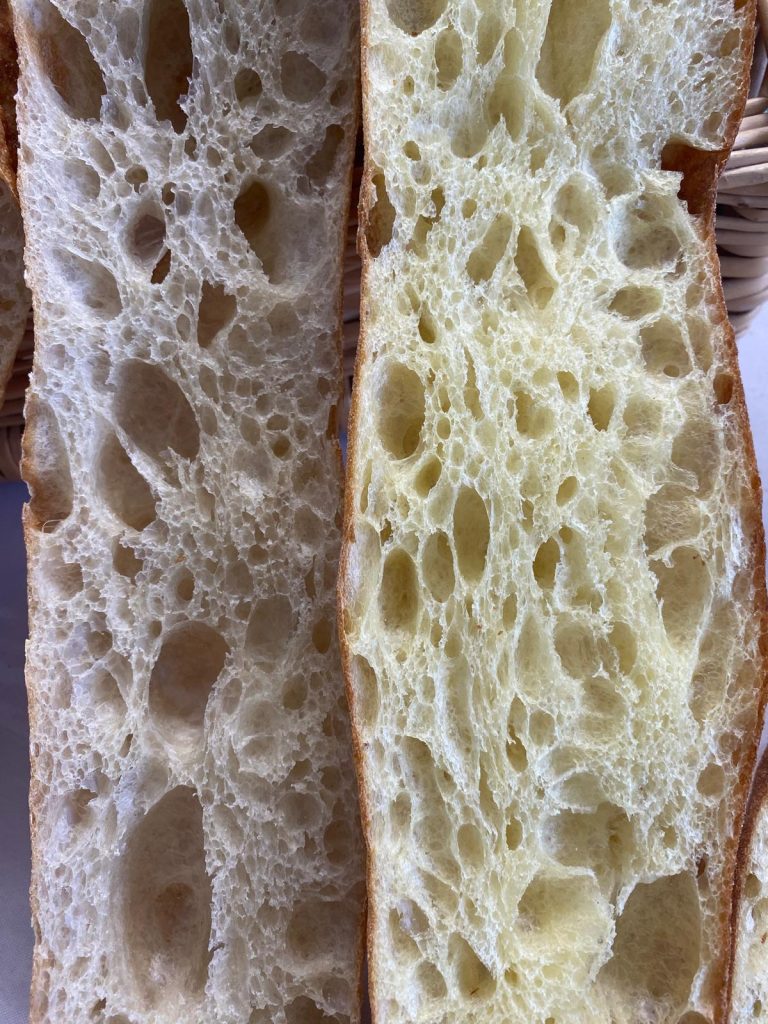
– The reinvented Baguette: The addition of durum wheat flour produces a baguette with a crisp crust, an appetizing creamy/yellow color and an extended shelf life. (see Photo)
– Focaccia & Snacking: Durum wheat is the ideal ingredient for high-moisture doughs such as Focaccia or sandwich breads (buns, sandwich loaves for Katsu Sando). It ensures excellent process tolerance, good resistance to freezing and prevents the bread from drying out during prolonged exposure in refrigerated display cases.
In conclusion
Although the price of durum wheat flour is 30 to 40% higher than that of soft wheat flour, due to the complexity of its extraction and its rarity, the economic calculation quickly proves to be a winner. Between the gains in hydration yield, the possible reduction in fat/eggs, and the unstoppable argument of a naturally “Clean Label” product, durum wheat is no longer a passing trend.
For today’s and tomorrow’s bakers, it’s an ingredient of excellence to enhance their know-how, surprise consumers and make a lasting contribution to the food transition. They can count on companies like Panzani Solutions, which have developed specific expertise and products to support bakers and confectioners.
Have you already tested durum wheat in your bakeries? Share your experiences in the comments or discover our training modules dedicated to new cereals on Baguette Academy!