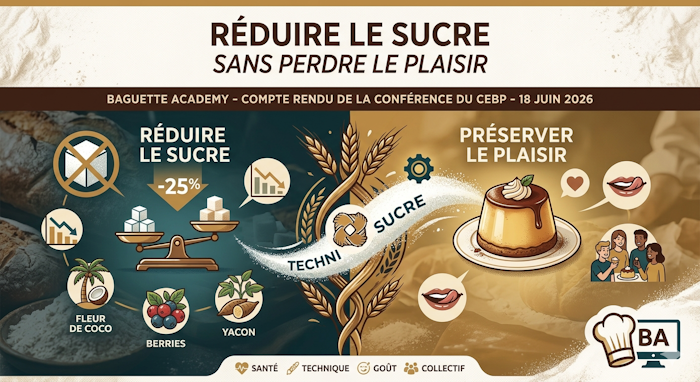
Less Sugar, Just as Much Pleasure: The Great Challenge for Tomorrow’s Bakery and Pastry Industry
On June 18th, experts and decision-makers from the sector gathered in Paris for the CEBP (Cercle d’Études de la Boulangerie Pâtisserie) conference to address a burning issue: sugar reduction. Balancing public health imperatives, sociological shifts, and technical innovations, the industry is organizing collectively to meet this challenge without ever sacrificing consumer pleasure.
At Baguette Academy—which is pleased to announce its official integration into the CEBP during this session—we break down the major challenges of this historic transformation for you.
1. The Sugar Paradox: Between Cultural Refuge and “Healthy” Consciousness
To successfully initiate a reduction in sugar, it is crucial to understand its socio-cultural impact. As historian and researcher Coline Arnaud (CHCSC) pointed out, sugar consumption has literally exploded, skyrocketing from 1 kg per person per year in 1850 to 35 kg in the early 2000s. Today, a striking paradox emerges: while sugar was once a precious commodity reserved for the elite, it is now the populations with fewer financial means who consume the most sugary products.
Sugar is not just a simple biological molecule; it is a cultural landmark. It embodies gatherings (the celebration cake), comfort, and sometimes even a form of “guilty pleasure” or transgression when snacking. Studies on current behavior also show that the modern consumer leads a true “dietary double life”: extremely disciplined and focused on healthy and organic products at home, they seek total indulgence (fat and sugar) the moment they cross the threshold of a restaurant, a coffee shop, or a bakery.
2. New Consumption Trends on the Ground
Bernard Boutboul (Gira Conseil) highlighted several major trends in the French market, which are essential to integrate into the management of your shops:
· Meal Fragmentation: We have gone from 2 traditional meals to 7 potential consumption moments per day! Lunch and dinner now account for only 68% of food intake, leaving the field wide open for snacks and sweet breaks, which are particularly captured by bakeries and coffee shops.
· The Success of Regressive Classics: The public is overwhelmingly voting for a return to the safe havens of childhood. Flan, tiramisu, and crème brûlée are experiencing phenomenal success.
· Visual and “Instagrammable” Purchasing: In-store merchandising or the cutting/finishing of desserts in the dining room dramatically boosts sales. The customer buys with their eyes first.
3. The “Baby Steps” Method: Reducing Without Substituting
How can we reduce sugar without disappointing the consumer? The industry is drawing lessons from the successful reduction of salt in bakeries (-20% since 2009 thanks to WHO criteria). The winning strategy relies on a policy of baby steps: a progressive and silent reduction, which allows the human brain’s sugar baseline to be re-educated without altering the immediate perception of taste.
The absolute trap would be to replace sugar with sweeteners, a false solution that maintains the dependency on sweet taste. The industry’s goal is ambitious yet realistic: a 25% to 30% reduction over the next 10 years. Note that an initial 10% reduction is technically achievable in a way that is completely invisible to the general public.
Focus: Technical Innovation at the Heart of Our Labs
Professionals are adapting and innovating to compensate for the loss of structure and shelf-life caused by reducing sugar:
· In Bakeries: Utilizing slow fermentation with natural sourdough, allowing the sugar content in brioches to drop from 25% to just 10-12%, while enhancing the dough’s aromas.
· In Pastries: Working on “sugar technology,” notably through caramelization to enhance flavor perception, and integrating natural gelling agents (pectins, inulin) to preserve the texture and structure of cakes (Jonathan Mougerl).
· Raw Materials: Utilizing naturally flavored sugars (coconut blossom, yacon, agave, fruit sugars) and using premium quality cocoas to mask the sugar reduction through aromatic intensity.
4. Sector Proactivity Against Fiscal and Technological Threats
Faced with the permanent threat of a punitive “sugar tax” on food (similar to the doubling of the beverage tax in 2024), manufacturers and artisans represented by ANIA are choosing proactivity. A draft voluntary collective agreement has been submitted to ministries to manage this reduction in a concerted manner.
The current goal is to achieve the backing of 80% of the market share per product category to officially validate the agreement.
Furthermore, two major technological disruptions are looming on the horizon:
· The Impact of Anti-Obesity Treatments (GLP-1/Ozempic): In the United States, 16% of the adult population uses these appetite suppressants, leading to a 20%
to 25% drop in volume for sweet snacks. This wave is expected in France within 4 to 5 years.
· Ingredients of the Future: The scheduled arrival of “rare sugars” and sweetening proteins derived from synthetic biology (brazzein, miraculin), expected in Europe within 6 to 7 years.
Baguette Academy Joins the CEBP: Digital Training Serving Artisans
This conference was also marked by excellent news for our team: Baguette Academy, represented by Emmanuel Tertrais, officially joins as a new member of the CEBP. This membership is a wonderful opportunity to put digital training at the service of supporting artisans and industrial players through these essential transitions.
Which Actions Can You Test in Your Businesses Today?
To respond concretely to the challenges discussed during this morning session, we encourage you to launch pilot projects:
1· Initiate a progressive and discreet reformulation process for your flagship recipes.
2· Develop a “gourmet break” offer in the afternoon to capture new consumption moments.
3· Integrate subtly revisited traditional “regressive” desserts into your menus.
4· Organize workshops or events around “taste education.”
The date is already set for the next CEBP meeting on October 15th, which will focus on a theme at the heart of our values: collaboration between industry and craftsmanship. Stay tuned!