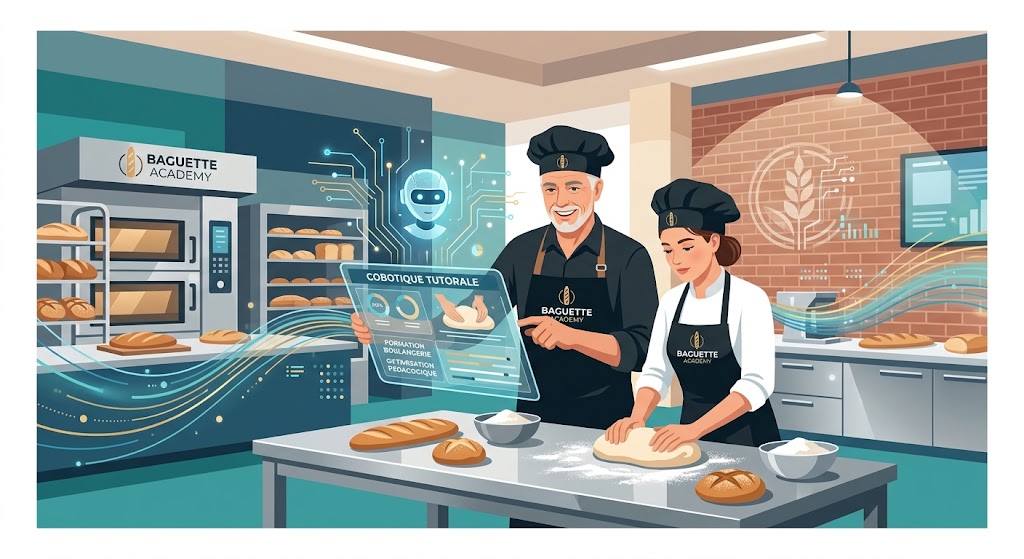
Dans le monde de la formation en ligne et du digital learning, l’intelligence artificielle suscite autant de fascination que d’interrogations. Peut-elle remplacer un formateur boulanger ou un tuteur pédagogique ? La réponse est claire : non. En revanche, elle peut devenir son meilleur allié.
This is the principle behind “tutoring cobotics,” a concept theorised by Jacques Rodet, a digital learning
consultant and researcher. Derived from robotics, the term “cobotics” refers to direct collaboration between
humans and machines. Applied to training, it means bringing AI and human tutors together as a team to
provide support that is more responsive, seamless and human. The term “tutoring cobotics,” developed by
Jacques Rodet, a digital learning consultant and researcher, describes collaboration between artificial
intelligence and human tutors to strengthen learner support. The goal? To make the most of each party’s
strengths: AI’s availability and speed, and humans’ empathy and critical thinking.
At Baguette Academy, we believe technology should serve artisanal expertise and enhance the
contribution of trainers. Let’s explore how this synergy is transforming the learning of breadmaking and
pastry skills

1. Two Complementary Strengths: Availability vs. Empathy
Each participant in the tutoring process has unique strengths:
AI: Speed, availability and data processing
Tutoring cobotics aims to optimise learner support by combining the strengths of AI (availability, speed and
data processing) with those of humans (empathy, critical judgement and personalisation).
A chatbot or virtual assistant is available 24/7. Chatbots, for example, are very effective at answering
questions about training content. They also have the advantage of being available around the clock—
something that cannot reasonably be expected of human tutors. A learner reviewing dough mixing or
calculating hydration at 10 p.m. can get an immediate answer about a formula or technical term
Humans: Empathy, critical judgement and teaching skills
Tutoring cobotics aims to optimise learner support by combining the strengths of AI (availability, speed and
data processing) with those of humans (empathy, critical judgement and personalisation)
AI remains limited in motivational, socio-emotional and metacognitive areas. It cannot detect uncertainty in
the voice of a craft baker changing careers or encourage a learner who feels discouraged after a batch of
dough has gone wrong.
In short: AI handles immediacy and raw information; the human tutor provides advice, kindness and real-
world experience. The goal? To make the most of each party’s strengths: AI’s availability and speed, and
humans’ empathy and critical thinking. Tutoring cobotics therefore aims to optimise learner support by combining the strengths of AI (availability, speed and data processing) with those of humans (empathy,
critical judgement and personalisation).
2. How Should Tasks Be Divided in Practice?
To build this collaboration without undermining the quality of training, three simple questions should be
asked: What does the human tutor not know how to do, cannot do, or does not want to do?
Tasks that can readily be delegated to AI
Managing reminders and repetitive tasks: progress follow-ups, notifications and deadline reminders.
Frequently asked questions (FAQs): answering recurring questions about the programme or basic
definitions
Detecting early warning signs of disengagement: on an e-learning platform, AI can identify a learner
who has not logged in for several days or is falling behind with their modules. Based on the activity
data learners leave on a platform, AI can identify possible early signs of disengagement—for example,
someone who stops contributing to a forum or submits assignments late. These signs can be difficult to
spot when a tutor is supporting a large number of learners. AI can therefore flag people who may be at
risk of dropping out
What MUST remain human :
Diagnosis and support: if AI flags a risk of disengagement, it is up to the tutor to pick up the phone or
send a message to understand the cause of the problem (a personal issue, a technical difficulty or a
problem with a recipe). The human tutor must then decide what kind of intervention is appropriate. The
tutor must decide whether to contact the learner, understand what they are going through and assess
the situation. For example, a learner who is struggling may be experiencing technical or personal
problems, or may simply not have understood the content. AI cannot distinguish between these causes
without risking error. A human tutor, on the other hand, can adapt their support through dialogue
Ethics and educational decisions: the decision to intervene or adjust a learner’s pathway must always
be made by a human
3. Individualisation vs. Personalisation: The Real Difference These two concepts are often confused:
Individualisation (the role of AI): adapting the next set of exercises based on quiz scores or identified
learning gaps
Personalisation (the role of the human tutor): taking the learner into account as a whole—their doubts,
ambitions, plans to open a bakery, or career-change project.
Conclusion: Towards a More Structured Approach to Tutoring Cobotics
Without necessarily using the term, many trainers already practise tutoring cobotics in their daily work. The
challenge in the years ahead is to structure this partnership: using AI’s speed and power to free up human
time for what matters most—listening, teaching and empathy.
To this end, our educational coordinator will take part in a workshop run by Opcommerce in order to:
• Understand the mental-health challenges faced by young people and apprentices.
• Identify early warning signs and vulnerable situations, and adopt the right approach when supporting a
learner in difficulty.
• Learn about the resources, organisations and support schemes available.
• Prevent learners from disengaging because of psychological difficulties.
LINKEDIN
Have you heard of the concept of “tutoring cobotics”?
Theorised by Jacques Rodet, a digital learning researcher, cobotics refers to direct collaboration between
AI and humans
The idea? To get the best of both worlds
⚡ On the AI side:
• Available 24/7
• Handles repetitive tasks (follow-ups, reminders and answers to FAQs)
• Detects early warning signs of disengagement on learning platforms
🧠 On the human tutor’s side:
· Empathy, listening and critical judgement
· In-depth analysis of the real causes of difficulties (personal issues, uncertainty or technical questions)
· Building a genuine relationship of trust
💡 The key takeaway:
At Baguette Academy, a pioneer in online training for the bakery, viennoiserie and pastry (BVP) sector, we firmly believe that technology should free up time for what matters most: human support and the transmission of practical skills and professional know-how.
🌾🍞 Our educational coordinator will take part in a workshop run by Opcommerce, which will give us practical guidance to better understand the difficulties some young people face, strengthen our support practices and help create a safer, more inclusive learning environment.
👇 And you, what role do you give AI in your training programmes?

#DigitalLearning #AI #VocationalTraining #Cobotics #Elearning #BaguetteAcademy #Teaching