🥖 📶 The Baguette Index !?!
The Irish have their Guinness Index (Guinndex)… The French can now discover the baguette version with the “Baguette Index.”
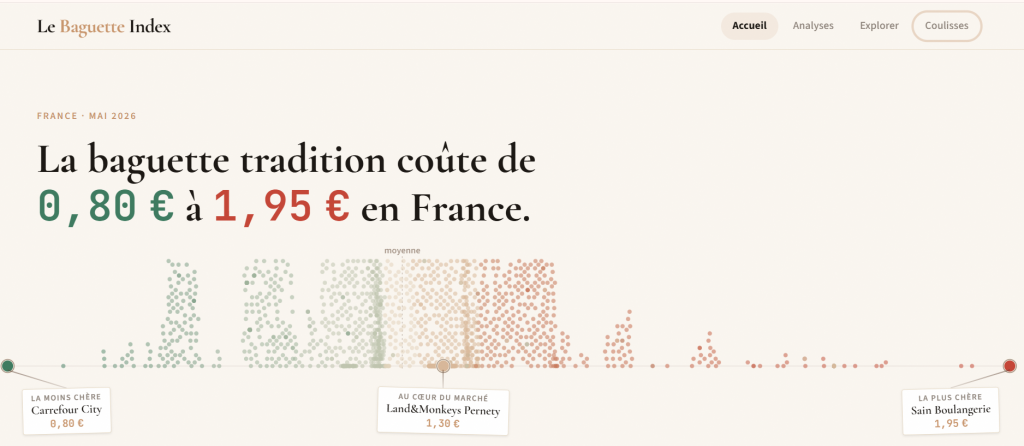
This map compares the prices of traditional baguettes across France by simply entering a postal code on the website: https://lnkd.in/eBUT3rGu
“A traditional baguette costs on average €1.25 in France, with a standard deviation of only 14 cents. Nearly one third (31.5%) of bakeries charge exactly €1.30.” – (Source: BaguetteIndex)
Created by two young French entrepreneurs, their AI “Brigitte” made more than 11,190 calls and collected 1,639 prices. They encourage French people to continue updating the pricing data.
Their website explains their approach and shares transparent statistics from their study.
Beyond promoting their AI agency, the two brothers also defend their own vision of bakery culture.
In the “behind the scenes” section, readers can find a complete analysis of prices by region and by type of bakery. AI enthusiasts will also discover the entire creation process of this AI agent and the tools used.
1. A surprising harmony of prices (the “Focal Point”)
- The figures: The average price of a traditional baguette in France is €1.25, with a median of €1.30. The standard deviation is extremely low (14 cents), and 55% of the market is concentrated around only two prices: €1.20 and €1.30.
- The explanation: Without any coordination or cartel, bakers naturally converge toward a focal point. This is explained by the 1993 decree strictly regulating the recipe of the “tradition” baguette (making the product nearly identical everywhere) and by artisans’ fear of appearing too expensive compared to nearby competitors.
- Geography driven by income level, not tourism
- The observation: Contrary to popular belief, the highest prices are not found in tourist areas, but in wealthy residential towns.
- The extremes: The cheapest cities are Tours and Limoges (€1.14 on average). On the other hand, the most expensive are affluent Paris suburbs such as Neuilly-sur-Seine (€1.37) or Chamalières (€1.35).
- Within Paris: The same pattern appears. Prices soar in wealthy or trendy (“bobo”) districts (3rd district at €1.38, 8th and 16th at €1.37), while more mixed or working-class districts remain more affordable (12th district at €1.21). Prices adapt to residents’ income levels.
- Weight does not influence price
The study reveals an almost nonexistent correlation ($r^2 = 0.003$) between the baguette’s price and its weight. Whether it weighs 200 g or 320 g, the price remains almost the same.
What consumers are really paying for is not the raw material (flour), but labor costs, energy, rent, and the artisan’s expertise.
- The end of the “Chains vs Independents” myth
The bakery chain market is not homogeneous and can be divided into two distinct strategies:
- Low-cost / high-volume chains: (E.Leclerc at €0.96, Ange or Marie Blachère around €1.10) democratize the product through low prices.
- Premium chains: (Paul at €1.33, Maison Kayser at €1.37) target affluent neighborhoods and capitalize on strong brand image.
- Independent bakeries: Positioned right in the middle of the market with an average price of €1.27.
- The “Crumb Matrix”: gems and traps
By comparing bakery prices with Google ratings, the study identifies several categories and reveals an excellent surprise:
- The Gems: Nearly one bakery out of two (769 establishments) offers bread rated above average while remaining cheaper than the median price. France remains a country where you can eat very well without paying a premium.
- Tourist traps & prestige bakeries: They make up the rest of the sample, concentrating the highest prices (whether justified by quality or not).
- The real impact on family budgets
The choice of bakery and place of residence has a concrete long-term financial impact. For a family of four consuming two baguettes per day:
- The yearly difference between an average artisan bakery and a Leclerc supermarket amounts to €234.
- A Parisian household will spend €134 more per year than a household in Tours for a strictly identical product, illustrating the invisible “cost of geography.”